

I'm thinking about banning AI for drafting at Zmist & Copy.
Folks can (and should) use AI for research, criticizing their outlines, rephrasing specific places that don't sound right, and much more, but they can't use it for writing their first drafts.
AI has produced enough slop that people can spot it. When readers suspect AI wrote something, they may dismiss it before considering whether it has anything worthy of reading.
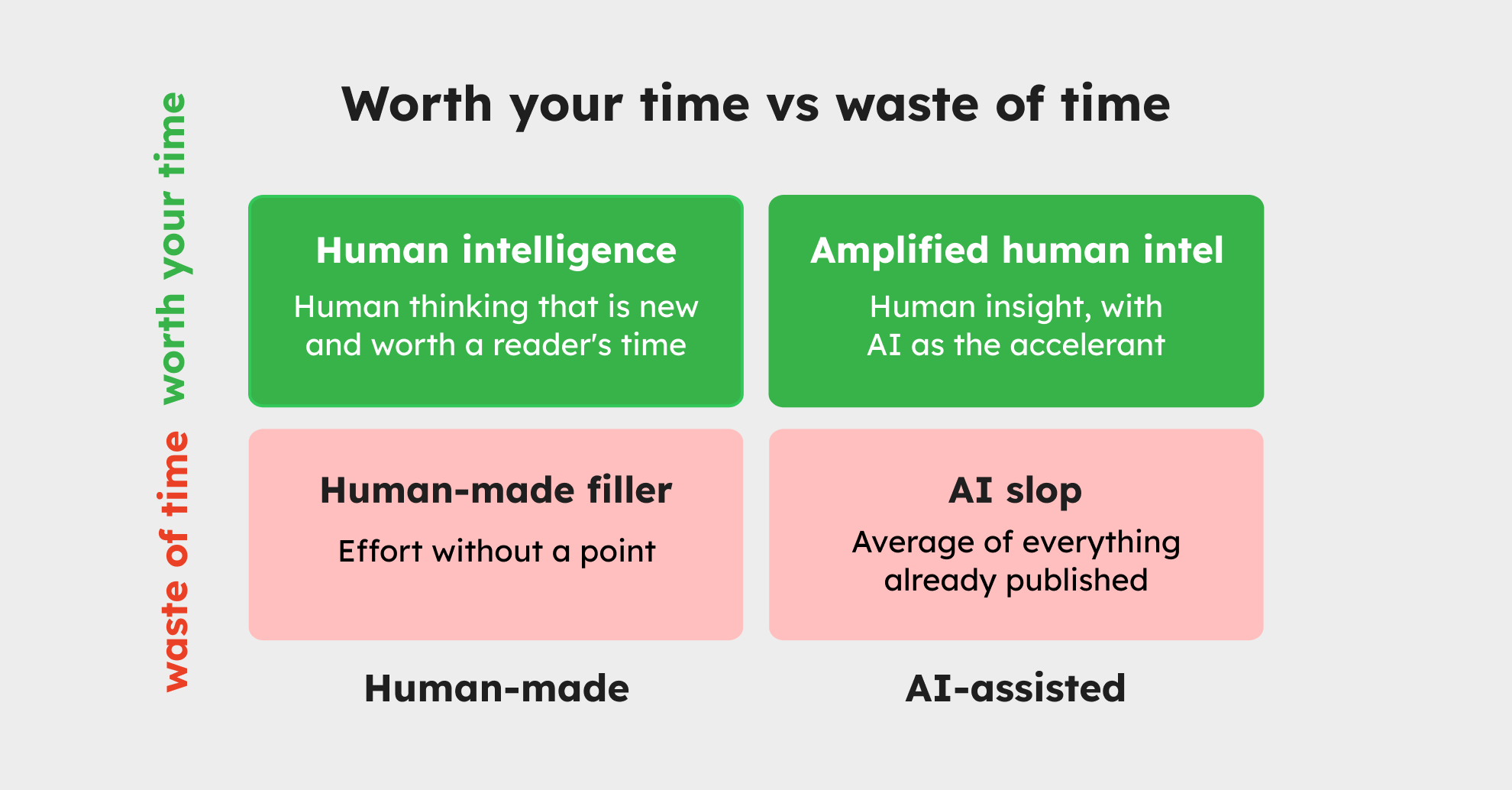
That judgment has a flaw because human-written content can be terrible. AI-assisted content can be useful. In other words, the origin of a piece doesn't determine its value.
But I also have to acknowledge the reality. If somebody suspects AI wrote our content, it risks undermining the value of our work.
Here's how I'm thinking about the problem, and what I want to change at Zmist & Copy.
In today's newsletter:
Let's start with what we actually sell. You can call it quality content. To me, that means content worth consuming.
AI has changed the economics of content creation making production cheaper and faster than ever. But that doesn't eliminate the need for something worth reading.
So what makes people want to consume a piece of content?
In one study, researchers tested how people judge human-written versus AI-generated text. They found that participants struggled to distinguish the two in blind tests, but preferred text labeled “human-generated” more, even when the labels were deliberately swapped and the text was AI-generated.
Believing that AI was involved can influence how we judge content, independently of its quality.
We want to believe that human-written content is better. But human beings have always produced generic, poorly researched, and badly written work! Removing AI from the process doesn't magically make an article worth reading.
Likewise, a piece created with AI can contain an original idea, offer a useful perspective, or solve a problem.
Human authorship isn't a guarantee of value.
Yet if we're so focused on whether AI was involved, we risk overlooking if this piece has anything worth saying.
An artist can create something unlike anything that came before and still struggle to find an audience. A writer can express an unconventional idea nobody wants to read. A company can build a product nobody needs.
Originality doesn't guarantee commercial success, cultural relevance, or even interest. Value exists in the relationship between what we create and the people who encounter it.
For content to have economic value, someone must want to read it or act on it. It has to matter to someone.
That's why I don't think the writer's goal should be to produce original content for originality's sake. They need to aim to produce something differentiated that serves a purpose.
When I want to learn about something, I rarely start with Google. Search often gives me variations of advice I've already seen. Instead, I go to the blogs of people and companies I know have something interesting to say.
I'm looking for a perspective I haven't encountered, an argument that challenges what I think, or an insight that helps me understand something differently.
Differentiated content gives people a reason to choose one source over another. That kind of content can be created with or without AI.
What matters is who identifies the problem, chooses the angle, brings in the expertise, and decides what is worth saying. Which brings me to the real reason I'm considering banning AI drafting.
Writing isn't just the process of turning ideas into sentences. It's also how we discover and develop those ideas.
A writer starts with observations, does research to connect the dots, and forms a hypothesis. As they write, they find strong and weak arguments, and discover the point they couldn't quite articulate before.
When an LLM writes the first draft, it gives the writer a version of the argument before they've developed their own.
The writer's job shifts from discovering what to say to improving what has already been said. They end up editing the average instead of building the differentiated.
Of course, a skilled writer can challenge an AI-generated draft and turn it into something original. I'm not arguing that it's impossible. But starting with a generated draft creates a risk I don't want to take with the kind of work we sell.
At Zmist & Copy, we work with B2B tech companies to clarify their positioning and turn their expertise into content that builds authority and generates organic pipeline. That requires understanding a client's business, finding the right argument, and identifying what they can say that others can't.
If we outsource the development of that argument, we risk outsourcing part of the very thing clients pay us for. I want our writers to develop the argument, not just edit its AI-generated version.
Writers can do the work without AI. But a human-written first draft doesn't automatically make the final piece good. I don't want content that escapes criticism simply because a human wrote it.
I want writers to use their expertise and editorial judgement to create differentiated content that's strategically aligned with the client's business. I want it to be engaging, easy to follow, well formatted, and visually supported.
And I want the result to be good enough that readers can focus on whether they find it valuable, rather than getting distracted by the suspicion that it was generated by AI.
To make that standard actionable, I'm introducing a self-checklist based on the six dimensions of our Content Quality Score:
1. Strategic alignment
Read more: Right topic, wrong article
2. Structure
Read more: Well-written and impossible to follow
3. Originality
Read more: Thoroughness and originality aren't the same thing
4. Engagement
Read more: What makes writing engaging
5. Formatting
Read more: Stop formatting like ChatGPT
6. Visual support
Read more: Google Docs don't get published
The final test
I'm doing a big reconstruction of our processes. Writing is the first part. Strategy is going to be next. Will tell more in my future newsletters.
Kateryna
P.S. Need help with quality content? Zmistify your content with Zmist & Copy
P.P.S. If we aren't connected already, follow me on LinkedIn and Instagram. If you like this newsletter, please refer your friends.



Stop waiting for permission to have opinions about the content you write.
Subscribe to From Reads to Leads for real-life stories, marketing wisdom, and career advice delivered to your inbox every Friday.


