

Most content written for SEO was never meant to be read. It was meant to be found. That's a different goal, and it produces a different result: writing with no reason to continue past the first paragraph.
The problem got worse with AI. Now you can produce that kind of content in seconds, at scale, with a conversational tone, and with nothing inside.
Engagement is the fourth dimension in the Content Quality Score. A content piece can be strategically aligned, well-structured, and original. But if the writing has no forward pull, the reader won't have a reason to keep reading.
In today's newsletter:
Whether a reader has a reason to stay. There has to be something in the writing that creates a forward pull. It can be a claim they need resolved or a tension that hasn't landed yet, or a specific detail that reveals the writer knows something worth knowing.
Engagement is the only dimension where technical correctness is irrelevant. A piece can be perfectly formatted, strategically aligned, and logically structured. And still lose the reader in the second paragraph.
A few things.
The Godfather opens at a wedding. It doesn't open with an introduction to the Corleone family. You're already inside the world, and the world has rules you'll figure out as you go. That's in medias res (Latin for "into the middle of things").
In B2B it looks like this:
✅ "The redesign had been live for three days when the CEO called."
❌ "Website redesigns are a critical moment for any company." In medias res or nothing.
✅ "The best-performing article we've ever written has zero search volume."
❌ "Search volume isn't the only factor to consider when planning your content strategy."
✅ "We killed Reddit as a distribution channel. Here's what we replaced it with.”
❌ "There are several distribution channels worth considering for your content program."
✅ "In January 2025, ClickUp's blog had 1.19 million organic visitors a month. By April 2026: 28,790. They didn't stop publishing or optimizing their pieces for search. The strategy seemed right but something else was true at the same time, and it cancelled everything out." (This is true story, by the way, check out the breakdown here)
❌ "Even well-executed SEO strategies can sometimes underperform due to algorithm changes and shifting search behavior."
✅ "The article ranked #1 for two years. We deleted it. Leads went up the following quarter."
The specificity of "two years" and "the following quarter" signals this came from a dashboard. You keep reading because the writer has clearly seen something most people haven't, and you want to know what it is.
❌ "Sometimes removing underperforming content can have a positive impact on your overall content performance."
✅ "Good briefs don't guarantee good content. But every piece of bad content I've reviewed traces back to a bad brief."
❌ "Content briefs are an important part of the content creation process and can help improve quality."
✅ "We stopped doing keyword research for one client. Rankings went up."
❌ "While keyword research is a common SEO practice, its effectiveness can vary depending on the situation."
✅ "We had six weeks to prove the content was working. The contract renewal was on the table."
❌ "Demonstrating content ROI is important for maintaining client relationships and securing ongoing budgets."
✅ "I told them the content wasn't the problem. They didn't believe me. I showed them the data. They still didn't believe me. Then we looked at the sales process."
❌ "Content performance issues are often misdiagnosed. The root cause may lie in other parts of the marketing or sales funnel."
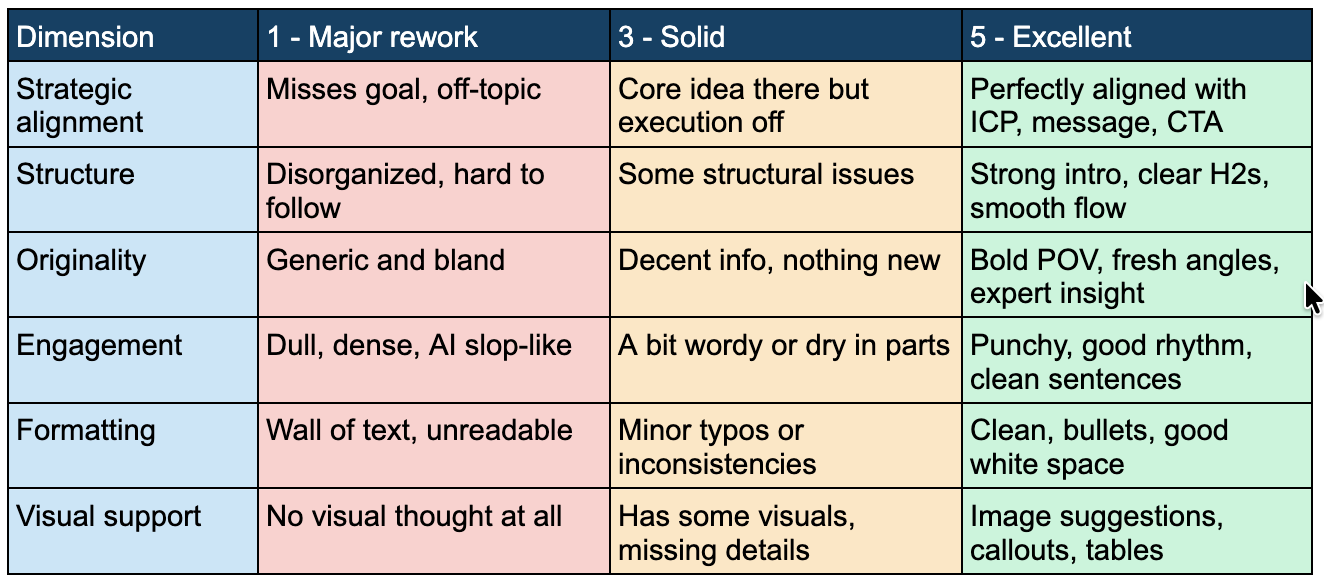
Score: 1 - The writing moves at the pace of someone covering a topic, not making a point. Padded sentences, universal claims, no material that required the writer to do the “digging” work. You stop reading and feel like you didn't learn anything new.
Score: 3 - There are moments of pull: a specific detail, an example, a claim with some edge. But they're inconsistent. The strong sections are surrounded by filler that slows everything down. You finish it, but you don't remember what you were supposed to take away.
Score: 5 - Every sentence earns the next one. The writing has a destination you can feel before you see it. Specific situations, stakes, details that could only come from someone who knows what they're talking about. You reach the end and the piece stays with you.
Note where you speed up naturally. That's where it's working. Note where you stumble, rush, or feel the urge to skip ahead. That's where it isn't.
Then give it to someone who doesn't know the topic. Ask them to stop reading the moment they lose interest.
Stopped before section two: score of 1.
Made it through but can't tell you what it was about: score of 3.
Told someone else about it: 5.
I've just wrapped up our LinkedIn Employee Posting Challenge.
My team learned so much about impressions, engagements, follower growth, and the power of consistency. We’re excited to share what we've learned with you soon. Make sure you subscribe to Zmist & Copy newsletter.
There are two dimensions left in our Content Quality score. Next week: Formatting. In previous chapters:
Kateryna
P.S. If we aren't connected already, follow me on LinkedIn and Instagram. If you like this newsletter, please refer your friends.
P.P.S. Need help with quality content? Zmistify your content with Zmist & Copy.


As Thomas Mann once said, "A writer is a person for whom writing is more difficult than it is for other people." And I agree. Writing is difficult. So is copywriting. In this article, I’ll try to make copywriting as easy as possible.

Marketing teams copy competitor keywords or publish content with no plan for distribution. Here’s the fix: a roadmap for content that ranks and generates leads. A playbook to follow.
Subscribe to From Reads to Leads for real-life stories, marketing wisdom, and career advice delivered to your inbox every Friday.


