

A client hired us to rewrite a blog post. They picked a relevant topic, even put the target audience in the title. Everything checked out.
But when I asked the content manager if she wanted this piece to generate leads or build trust through thought leadership, she couldn't answer.
That decision could make two completely different articles possible. One would position the company as experts who practice what they preach. The other would target a specific segment and drive them toward a service page.
It took a while to get that clarity. Once we had it, we wrote the piece. Within 20 days, it hit the top of Google for all target keywords and already generated leads for the company.

This is the first newsletter in a series breaking down each dimension of the Content Quality Score, the six-point system we use at Zmist and Copy to evaluate content before it goes live.
Strategic Alignment is the first dimension. And it exposes the most common failure in content teams: producing content that covers the right topic but has no connection to the company's positioning.
In today’s newsletter:
Strategic alignment checks whether someone made seven decisions in writing. If any of these are missing or vague, your piece will not achieve the marketing goals.
1. Audience match. Can you name the person reading this? Their role, their specific problem, where they are in the buying process. "Marketing agencies" was in the title of that blog post we wrote. But that told us nothing about what the reader needed or what we were solving for them.
2. Business goal. What does this piece do for the company? Drive demos? Build pipeline trust? Support a product launch? If the writer can't connect the piece to a business outcome, it will end up as content for content's sake.
3. Positioning goal / POV. What belief or perspective should the reader walk away with? Every piece of content needs to reinforce your positioning. If the article could have been published by any competitor, the positioning goal is missing. A strategically aligned piece leaves the reader thinking, “Only this company would say it that way.”
4. Differentiators. Where in the piece does the company’s unique approach show up? A strategically aligned article makes it clear why this company’s take on the topic is different from the other articles ranking for the same keyword.
5. Relevant proof. What evidence backs the claims? Client results, internal data, named examples, specific numbers. A piece with no proof is an opinion post, which can exist, of course, but we’re talking here about expertise-driven content in a competitive B2B context.
6. CTA. One next step that follows logically from what the reader just consumed. If you can’t define it before writing, the piece will end with a generic “contact us” that converts nobody. The CTA should feel like the natural conclusion of the argument you just made, not a banner stapled to the bottom.
7. Voice and style. The voice needs to match the audience, the channel, the brand, and the goal. Writers tend to default to whatever feels natural to them, and that may be wrong for the piece or the specific company this piece is written for.
These red flags show up in the first read:
How do you score strategic alignment? Let me give you some guidance on scores 1, 3 and 5.
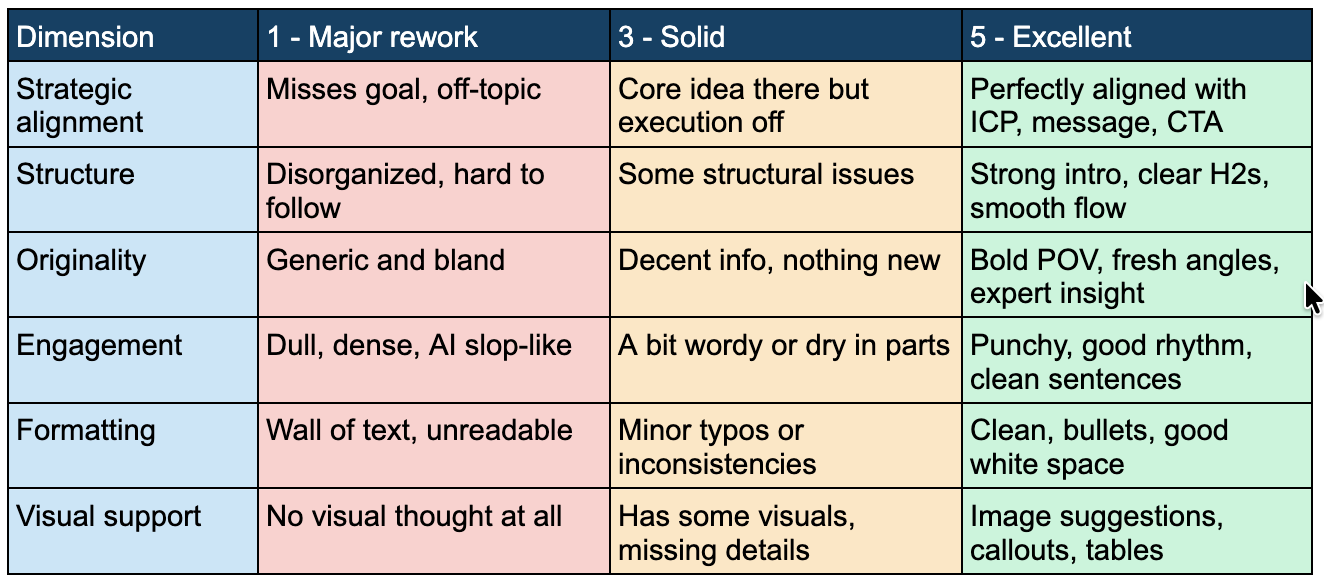
The draft opens with “Digital marketing agencies face increasing competition in today’s landscape.” The next 1,500 words list every client acquisition channel that exists: SEO, PPC, referrals, networking, social media, partnerships. All of them described at the same shallow depth. Nothing about why this company is writing this piece.
There is no perspective from the company. The CTA says “Contact us for more information.” More information about what? The article didn’t make a case for anything.
It this piece, the writer guessed every decision, and so the result is generic.
The audience is named and their problem is clear. The intro seems fine but isn't specific. The core of the piece makes sense but loses focus around the middle. For example, there is a section on “building your brand online” that doesn’t connect to the main argument about outbound sales. The POV is something like “outbound is underrated.” It doesn't stand out, it doens't make the reader think differently. The CTA is “Get in touch to discuss your growth strategy,” which ’s related, but not exactly something that will inspire conversion.
The writer understood the general direction but half the decisions were still unmade when they started writing, so they filled in the blanks with assumptions.
The draft opens with a scene: an agency owner who hit $1.2M in revenue on inbound alone, then watched lead flow slow down for six months. The first three sentences put the reader in a specific situation they recognize.
The piece builds one argument: agencies under $2M that depend entirely on inbound are one algorithm change away from a pipeline crisis. Outbound is the channel that gives you control over who enters your pipeline and when.
The company’s proprietary outbound process shows up in the piece as the framework the entire article is organized around. A case study features an agency that went from 3 to 11 qualified meetings per month in 60 days.
The CTA is “Book a free outbound ROI timeline projection.” It feels like the obvious next step after reading.
Every paragraph knows who it’s talking to, what the company stands for, and what should happen next. Remove the company name and the piece would feel incomplete, because the argument is built on their specific expertise.
I’ve written before about random acts of content. It's the habit of posting whatever, whenever, and hoping something works. Strategic alignment is the fix because it gives writers a specific checkpoint they can run before writing.
Before your next draft, check the seven decisions above. If you can’t fill them in, you’re not ready to write.
Strategic alignment is the first thing to get right because everything else (structure, originality, engagement) depends on knowing who you’re writing for and why.
Next week: Structure.
Kateryna
P.S. If we aren’t connected already, follow me on LinkedIn and Instagram. If you like this newsletter, please refer your friends.
P.P.S. Need help with quality content? Zmistify your content with Zmist & Copy.



Those who should know better are the ones suggesting "just automate it.”

Subscribe to From Reads to Leads for real-life stories, marketing wisdom, and career advice delivered to your inbox every Friday.


