
.png)
For years, the SEO industry taught content teams that longer is better. Writers were trained to cover every subtopic and related question, add more H2s in the body text, add FAQs with more H2s at the end. The more words on your page, the better chance it had to beat other pages in Google search results.
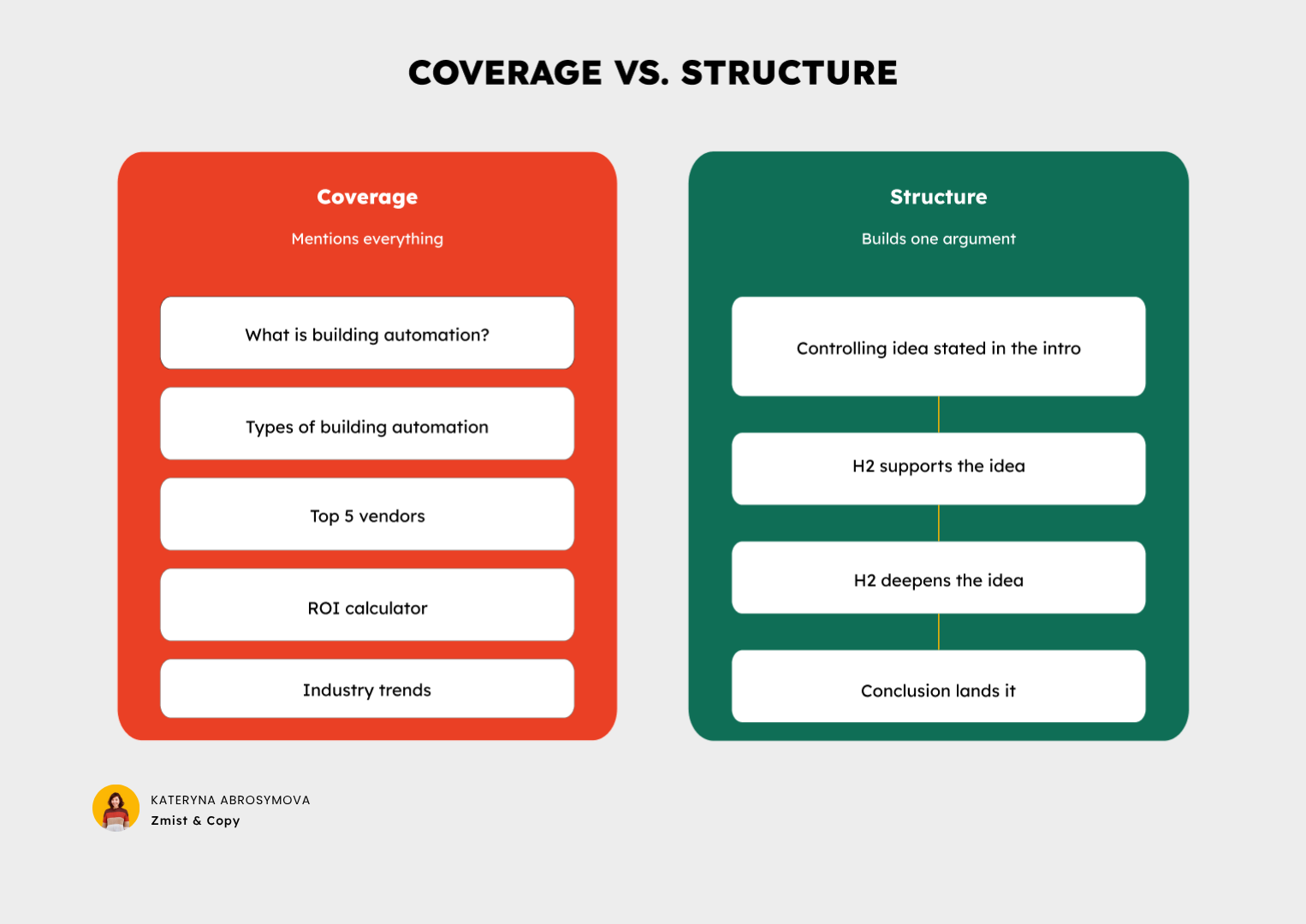
That era gave us the "Comprehensive Guide." Remember those? 4,000 words covering everything related to a keyword. What is X, why X matters, types of X, how to choose X, X best practices, X tools, X trends. Did I forget anything?
Oh, those pages had words! The topic was explored in every possible direction. What they didn't have was the argument.
Many teams still write this way. The writer covers as many subtopics as they can but there is no controlling idea holding it together.
A well-structured article and a comprehensive article are two different things. Coverage means you mentioned everything. Structure means every section builds toward one point.
This is the second newsletter in a series breaking down each dimension of the Content Quality Score, the six-point system we use at Zmist and Copy to evaluate content before it goes live.
Last week was Strategic Alignment. Now: Structure, our second dimension. It exposes a common failure in content: pieces that are well-written sentence by sentence but impossible to follow as a whole.
In today's newsletter:
Structure scores whether a piece is organized around one core idea that is stated in the intro, and whether every section builds on that idea without drifting.
Here are three things to evaluate in your writers’drafts:
The reader should know the argument within the first three paragraphs. If the intro is a warm-up ("The X market is continually growing..."), the structure has already failed.
Animalz calls this the thesis. I call it the controlling idea. It's essentially the same thing: the one sentence that makes every H2 accountable.
A controlling idea for an article about building automation systems could be: "Facility managers lose money because they evaluate building automation using IT criteria instead of operational criteria." That single sentence determines what gets included and what gets cut.
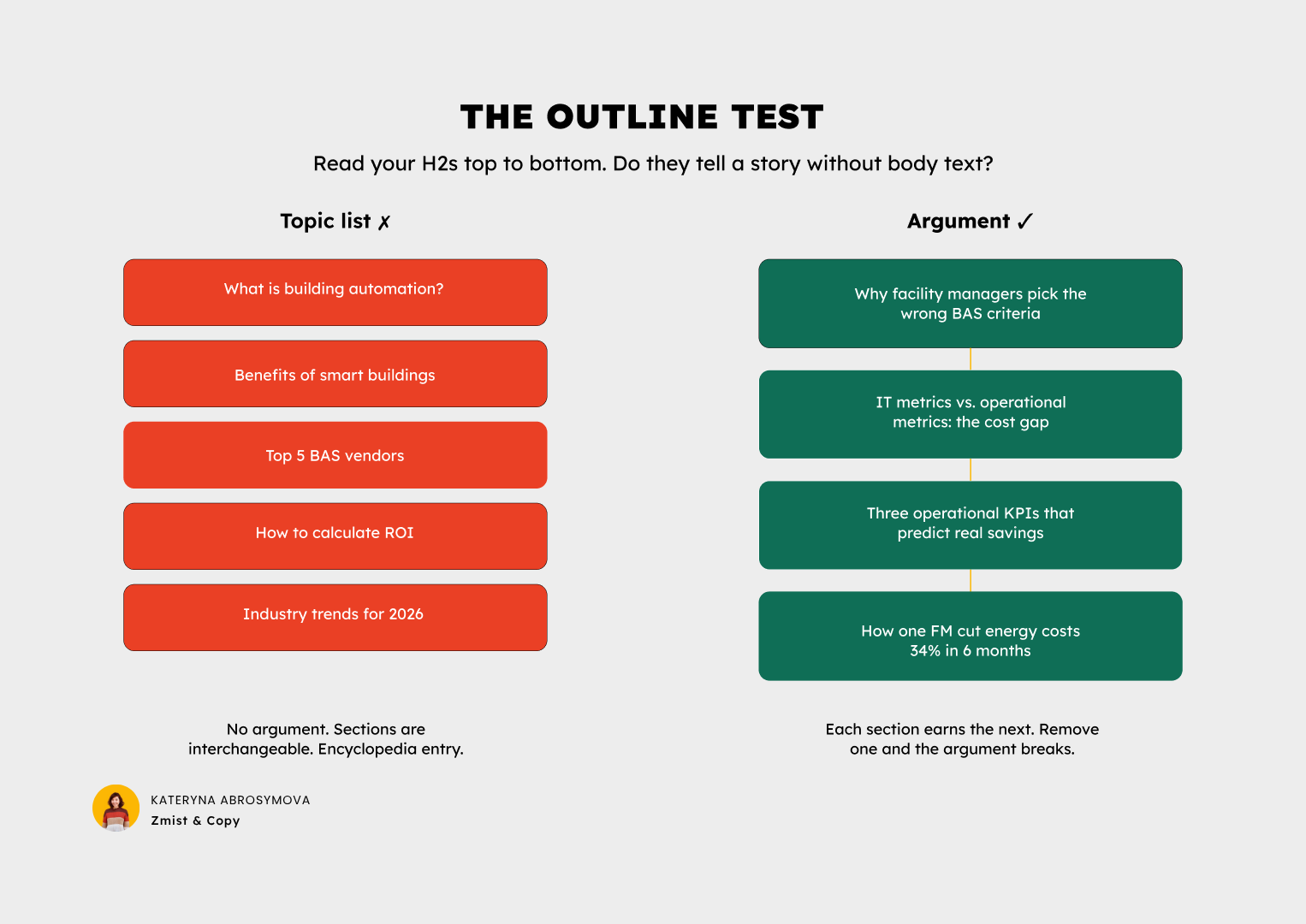
Read the H2s alone, top to bottom. Do they tell a logical story? Could you rearrange them randomly and the article would read the same? If yes, the structure is weak.
Each section should earn the next one.
Process articles go chronological.
Persuasion articles stack reasons.
Story articles follow a narrative arc.
If the H2s read like a table of contents for an encyclopedia, you don't have a structure.
If a paragraph makes an interesting point that has nothing to do with the thesis, cut it.
When a writer goes astray, so does the reader. I wrote about this in my cohesion and flow article: every paragraph needs to pass a simple test. What does this paragraph have to do with the main argument of the article? If you can't answer that in one sentence, the paragraph doesn't belong.
These show up in the first read:
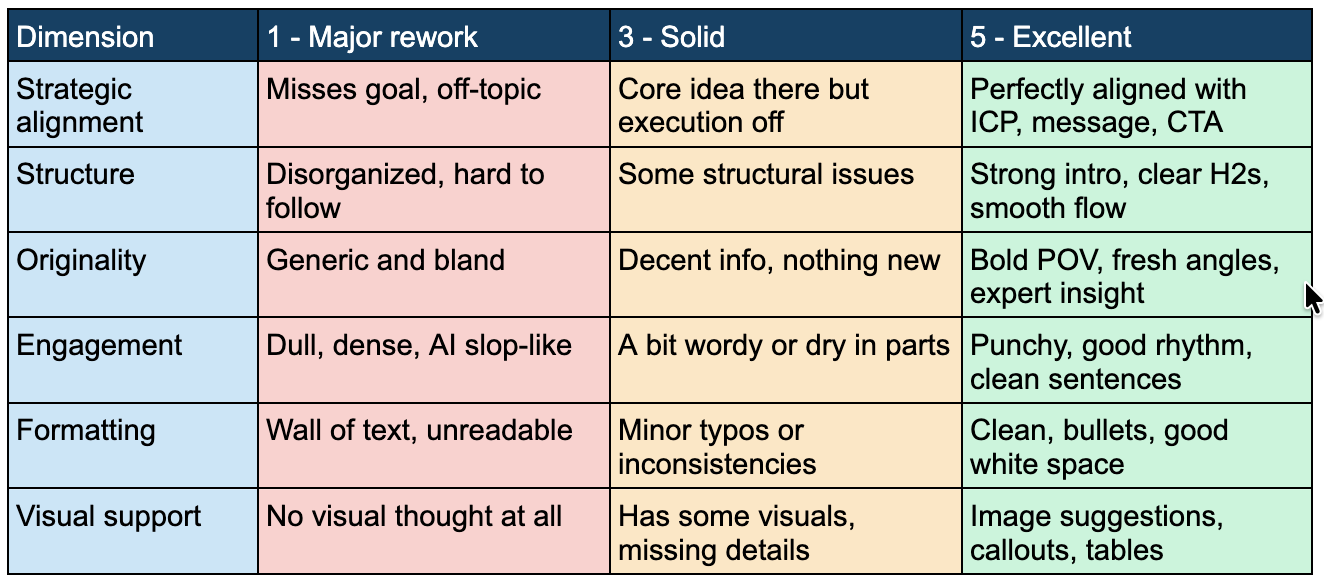
Score: 1 - Start from scratch
The draft covers a broad topic with no single argument. "Guide to Content Marketing" with H2s jumping from strategy to tools to hiring to measurement. The intro sets no direction. The reader skims, picks up a few isolated tips, and bounces.
The writer listed everything they knew instead of choosing one thing to prove. Often this happens because the brief itself was a topic, not a thesis. "Write about content marketing" produces coverage. "Argue that content marketing fails when writers don't own distribution" produces structure.
Score: 3 - Needs work
The controlling idea exists but loses focus by the middle. The intro does a decent job setting up the argument. Then somewhere around the third H2, a tangent appears.
Maybe the writer added a section about a related-but-separate topic because they found an interesting stat during research. Or the brief included a subtopic that doesn't quite fit the main argument but felt mandatory to include.
Cut the tangent, tighten the transitions, and make every H2 answer the same question the intro raised.
Score: 5 – Ship it
The intro states a specific argument. Every H2 supports it from a different angle. Each section earns the next. The conclusion lands where the intro promised it would.
Remove any section and the argument feels incomplete. Add a section and it would feel forced.
The piece reads like it was written by someone who knew exactly what they wanted to say before they started typing. Because they did.
Most writers think structure means formatting: bullets, H2s, white space. Formatting is dimension 5 in the Content Quality Score. Structure is about logic.
One habit that fixes most structural problems: before writing, state the controlling idea in one sentence. Write the H2s and read them top to bottom. If they tell a coherent argument without any body text, you have structure. If they read like a table of contents for an encyclopedia entry, you have a topic list. Go back and choose an argument.
Animalz has a useful method for this. They call it the 10%/30% outline. The 10% is your H2s telling the argument. The 30% adds supporting points under each. If the outline works, the draft usually follows.
Structure is the dimension that separates articles people finish from articles people skim the first three paragraphs of and close.
Next week: Originality.
In previous chapters:
Kateryna
P.S. If we aren't connected already, follow me on LinkedIn and Instagram. If you like this newsletter, please refer your friends.
P.P.S. Need help with quality content? Zmistify your content with Zmist & Copy.



Subscribe to From Reads to Leads for real-life stories, marketing wisdom, and career advice delivered to your inbox every Friday.


