

I came across a post on Threads this week that I couldn't scroll past.
Someone asked whether they can find an SMM specialist with B2B SaaS experience on Threads.
The top reply: "Better just build a team of agents and get a fractional CMO to orchestrate it.”
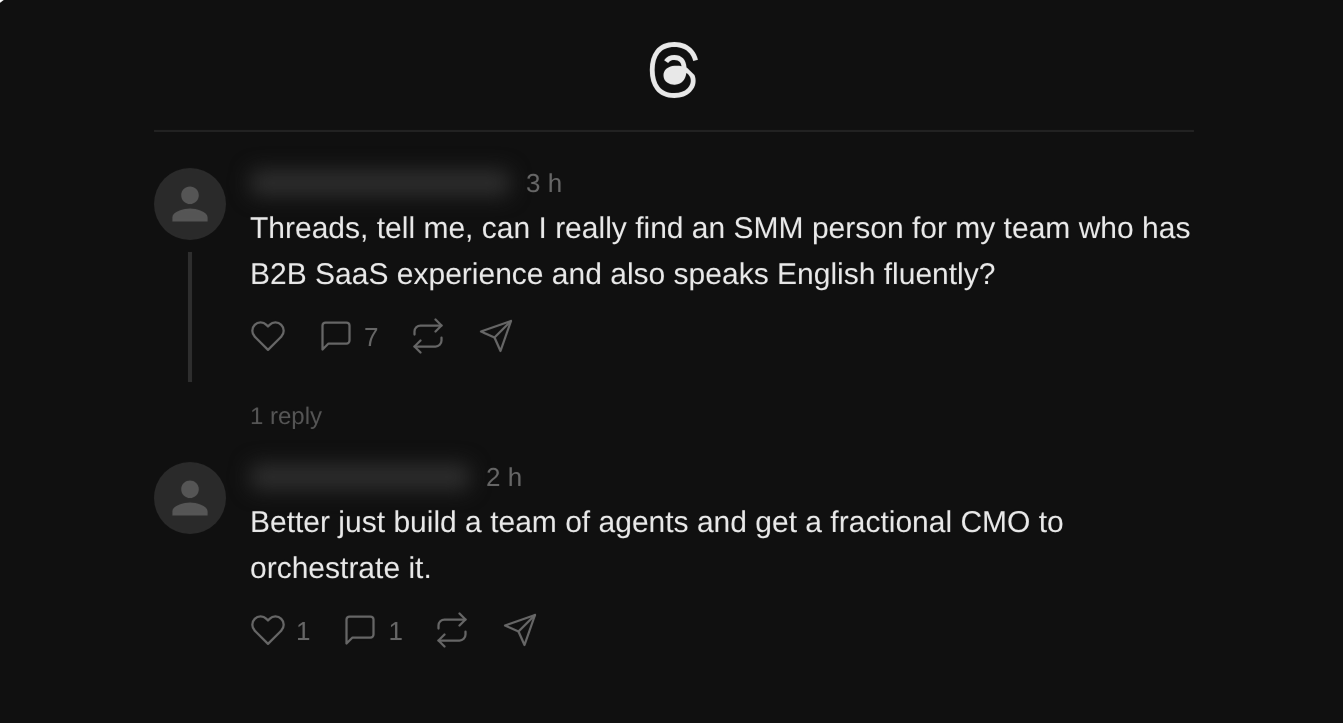
From a marketer. About marketing.
The take is surprising, to say the least. But I've been watching this argument creep into marketing conversations for a while now. It reveals where the bar for marketing is being set right now, and who's setting it.
If you think that the people who are lowering marketing's bar are founders who don't understand the function, or executives cutting budgets, that's not exactly true.
The people lowering marketing's bar are marketers. The people who are supposed to know what this work takes.
Here is the connection between “AI agents, orchestrated by a fractional CMO,” and “anyone can do marketing”: If AI can do the production, then anyone can do marketing. Which means no one has to be particularly good at it.
In today's newsletter:
For years, companies thought: if we don't get results from marketing, we need to hire more people and publish more content (the same is often advised by SEO experts). The result of this "strategy” is our modern internet: a place full of copycat content, AI slop, and people talking about stuff they don't understand.
The result is content that nobody needs. Why does it even exist? It doesn't serve the people it's targeting, nor does it serve the business it's supposed to help.
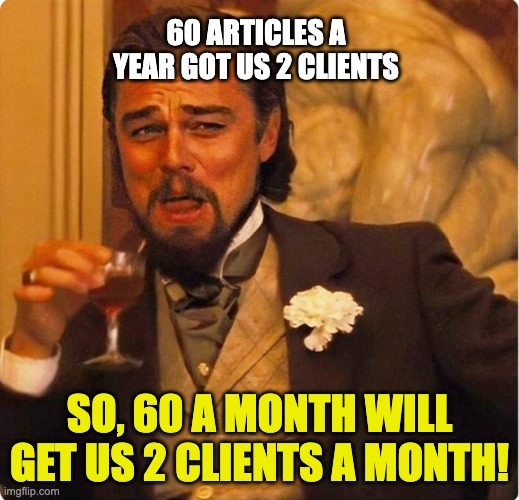
Check out my previous issue: More content equals more leads. Or?
I am not saying producing more content is necessarily a bad idea, I'm just saying the quantity of produced content is the wrong question to start with.
Last week, we published our first original research report by Zmist & Copy. We surveyed B2B content professionals on how their content volume changed in the last 12 months, how they're using AI, and whether any of it moved the needle on results.
85% of teams increased their publishing volume. That's not surprising. AI removed the production constraint, making it possible for a team of two to publish what a 10-people department used to.
But among the teams that increased volume significantly, nearly half saw no change in results.
When we asked teams what got harder after AI, 77% named generic content as their biggest new challenge. 37% said their content now sounds like their competitors.
Turns out, producing more of the same content that teams produced before AI, doesn't bring better results, which means "production volume” was never the problem.
If your content doesn't work, it's not because you don't publish enough. It's because you have nothing worth saying. And now you're publishing that at scale.
This is what the Threads top reply I was talking about gets backwards. The solution to "we have nothing worth saying" is not "automate the saying of it." That's how you get 1000 posts that all sound like AI slop.
Yuliia Kostik, our content strategist at Zmist & Copy, has been working with our AI research for months. In this week's issue of The Tilt, my company's newsletter, she put a name to what's separating the teams that are winning from the ones producing crap at scale.
Content Producers vs Content Thinkers.
Producers ask: How do we publish more?
Thinkers ask: What's worth saying?
Producers use AI to go faster. Thinkers use AI to pressure-test whether an idea is worth pursuing at all.
Producers measure success by publication count, traffic, keyword rankings. Thinkers measure it by pipeline attribution, direct replies, shares from the exact accounts they're trying to reach.
The result: Producers have lots of content, but their pipeline is flat. Thinkers have a flat content volume, but their authority and pipeline are constantly growing.
If you want to read Yuliia's full breakdown, and the following issues of Zmist & Copy monthly newsletter, subscribe to The Tilt.
AI can do a lot of the production work, true. But you can't treat the thinking as the optional part, the thing you automate.
In a world where production is free and volume is infinite, thinking is the only thing that matters.
You cannot push a button, produce a mountain of content, and call that marketing.
The bar in marketing is being lowered by people who believe thinking is something you can skip, just orchestrate AI agents, and you're good.
Yuliia built a 5-question self-audit to help you answer whether you're a Content Producer or a Content Thinker. It takes two minutes.
[Take the Content Thinker Self-Audit →]
If you got mostly Thinker signals, you're already doing a good job. The question now is how to systematize what's working. And if you want to pressure-test your positioning or content strategy, that's where Zmist & Copy can help.
If you got mostly Producer signals, start with our Brand Authority Content Audit Template. It will show you which of your existing pieces have a position and which are just occupying space.
If you are somewhere in between, that's honest. You know something's off. That usually means the gap is either in positioning (you can't articulate what your content stands for) or in process (you can articulate it, but it never makes it into the briefs).
Whatever your result, if you want to talk through what “content thinking” looks like for your team, shoot us a message.
Remember I told you I've been working on building an AI system with the feedback loop that automates how performance feeds back into strategy? I've completed the first big milestone! 💪 (thanks to my kid who gave me the privilege to work a couple of hours after he goes to bed without waking up every 30 minutes).
Next week, our performance reports for clients are going to build themselves automatically. I'll show you what that looks like in my next newsletter.
Kateryna
P.S. If we aren't connected already, follow me on LinkedIn and Instagram. If you like this newsletter, please refer your friends.
P.P.S. Need help with quality content? Zmistify your content with Zmist & Copy


On Friday, just before I was about to wrap up my workday and leave the office for the weekend, one of my clients sent me a message to Slack: "Have you seen the new ChatGPT? I wonder how it can be used in our SEO strategy…" I was like, "What's a ChatGPT?" (I'd never heard of it.) Read this article to learn what ChatGPT is and how you can use it to create content.

If else, it won't be valuable. Here is how to make it interesting.
Subscribe to From Reads to Leads for real-life stories, marketing wisdom, and career advice delivered to your inbox every Friday.


