

I read a client's voice guide this week. It said: Clear. Ambitious. Candid. Warm.
Beautiful!
Now tell me how this is different from anybody else. How does it help me actually write? And how does it make you memorable?
This voice is a fortune cookie. It sounds nice, but it’s useless. And unlike a fortune cookie, your brand won’t become memorable just because you’re “warm and candid.”
In today's newsletter:
Voice guides live a short life.
Teams spend weeks creating them, turning them into polished PDFs, making big events out of presenting them…and then nobody wants to open those PDFs again.
Ever wondered why?
Look. Here's how well-known companies describe their voices:
These descriptions read like every guy on a dating app: adventurous, easygoing, funny. But when you actually meet the guy…you quickly realise his Tinder description didn't tell you much.
Most voice and tone guides give writers nothing that helps them write. And they all sound the same. Do you really need one?
Sometimes you do.
The default way to communicate on the internet is clear, friendly, and informal. Nobody is aiming for unclear or unfriendly.
Writing "friendly and clear" in your beautiful PDF tells a writer nothing they didn't already assume.
But if your voice is out of the ordinary, that's when your writer needs to know. That's when you need a voice guide.
Here are some examples of what out of the ordinary means:
These examples show how your voice is different from “the default way to communicate.” But most teams don’t know what their version of different looks like, so they end up borrowing from brands like Mailchimp. Or defaulting to the same familiar “friendly, witty” style everyone else is using.
If you want to sound different but don't know how, read on. At the end of this newsletter, I'll tell you where you need to start to figure it out.
Until then, we have a couple more things to discuss about fortune cookies.
Your voice is a constant. It doesn't change. What about tone? The guide's called brand voice and tone (not just voice), right? The tone won't stay the same at all times, no matter how hard your guide tries to make it. You can't possibly predict all the use cases where your tone needs to change, and put it into your guide. This is the reason why writers (good ones) never consult the guide for tone.
Your voice and tone guide most likely says: “We're warm and friendly, and we use a conversational tone of voice.” Apparently, that means “let’s be buddies!” at all times.
Now, imagine a situation (the use case you can't predict): The war in Ukraine starts. Your company wants to publicly stand with Ukraine and condemn Russia’s invasion. How do you want the message to sound? Friendly and warm or angry and uncompromising?
This is not the moment for “Hey everyone, this is really sad 💔 Let’s all hope for peace.” You want to say: “The terrorist state, ruled by a psychopath who can't keep himself in power unless he starts another war, just invaded Ukraine for no reason. We can't stay silent, and we won't. We stand with Ukraine. If you're with us, here is what you can do...”
You need a tone that drops the friendliness and speaks with conviction.
Tone is never a constant. It adapts. And adapting tone is the natural instinct of a good writer. You can't pre-script that in an if-this-then-that table.
So tone is off the table. The only thing you can do about tone is put “consider the user’s state of mind” into your guide. That's it.
There's one more thing about the voice guide that people misunderstand.
Two people on your team write "first" and "1st" differently. One capitalises after a colon, one doesn't. One starts sentences with "and," one thinks it's a crime.
Problems like this often get solved with a voice guide. They're worth fixing, but they're not about voice. They're about style. You don't need to invent a style. You can borrow it from Associated Press Stylebook or Chicago Manual of Style. Your voice guide can just have a short list of words, such as your product names, or something that existing manuals don't have.
Okay, now that we have tone and style figured out, let's go back to the voice.
Teams want their voice to be different, but have no idea what that means, so they reach for the same warm adjectives and end up back at the fortune cookie.
If you want to define a voice that’s genuinely different, start with the enemies.
Sarah Suzuki Harvard put it best in her LinkedIn post. A voice guide starts working, she says, the moment it names not just what you sound like, but what you refuse to sound like. The words you'd rather die than use. The joke you'd never make.
A real voice has enemies.
That's the part missing from every fortune-cookie guide. "Warm, clear, candid" has no enemies! So it tells you nothing about how you're different.
Here is how we build voice guides for clients. Every rule comes with its enemy attached:
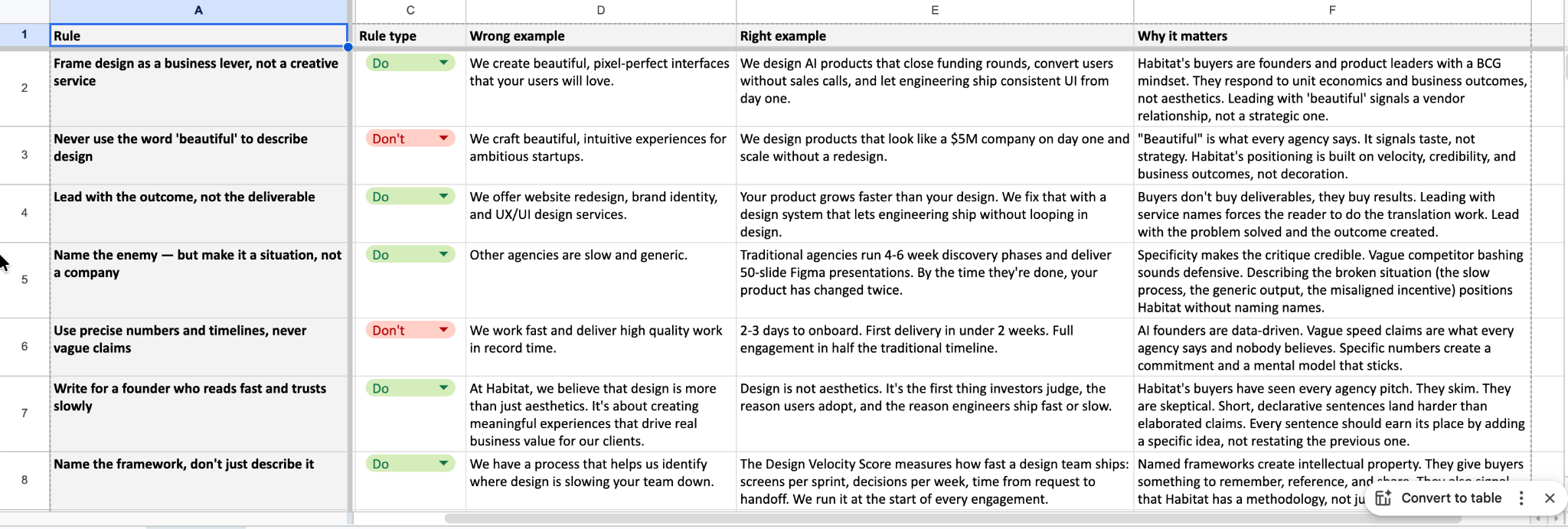
The wrong example is the enemy. Put it right next to the rule, and the abstract becomes obvious. Nobody has to interpret "be direct" and hope they got it right. They can see the sentence we'd never publish sitting next to the one we would.
You can pull enemies out of the people who have the voice.
We ran a LinkedIn program for a client where the goal was to create a LinkedIn strategy for their employees. To do that, we needed to extract each person's personal voice. So we interviewed them, then ran a calibration exercise: we wrote the same short post four times, each in a different voice and tone, and asked:
Which one sounds like you? And which words and sentences would you never say?
One person came back with this:
Many of the versions below have grammar that includes sentences that are not complete. This is an absolute no for me. I do not write in verbal tone, but rather follow AP style guide formatting. things I would absolutely never say: Can you believe it? Smart people, Sit on.
That comment did more for us than any adjective could.
That was for a personal voice, but the exercise works just as well for a company. It helps you figure out how your company is different and develop a distinctive voice.
Here is how to decide.
Mailchimp's voice guide is more famous than Mailchimp. Makes you think.
Kateryna
P.S. If we aren't connected already, follow me on LinkedIn and Instagram. If you like this newsletter, please refer your friends.
P.P.S. Need help with quality content? Zmistify your content with Zmist & Copy.


Headline formulas don't work unless you understand why they work. Learn how to create a magnetic headline by asking 9 questions to your first working title.

Subscribe to From Reads to Leads for real-life stories, marketing wisdom, and career advice delivered to your inbox every Friday.


