
.png)
I got this message from a new client on Monday:
"Unfortunately, there won't be a match in our collaboration."
It arrived after we’d spent three weeks researching 18 internal documents, building a bot to navigate their FAQs, writing two full articles, and creating and getting approval for the brief for one of them.
I stared at the screen. Confused. We’d never been fired for bad writing before.
In this newsletter:
Our collaboration with this client started with a call about their content. Stuff like the types of articles they publish, who they look up to, what their briefs look like, and how “our boss likes reading our blog,” which apparently made it very important that we do a great job.
We didn't get a single onboarding call about the market they're operating in, their target audience or the topic of the writing assignment.
Instead, we got eighteen documents dumped into a folder (some of them outdated and contradicting each other), together with links to six blog articles and some case studies.
They invited us into a Slack channel without introducing us to the team, explaining who is who and how collaboration works.
Hm, I thought. This feels like being treated like freelancers in the worst possible way.
We accepted this setup, with all its red flags.
We thought: "We're professionals. We'll figure it out."
So we did what good agencies do: read everything, systematized their knowledge, and filled in the gaps ourselves.
Our brief got approved without a single comment. The first article approved too (even though we were blamed for inaccuracies that came directly from their own documentation).
And still “there won’t be a match.”
Some clients expect writers to understand unstated priorities (read their minds), fix outdated or conflicting materials and think like internal team members right off the bat. But at the same time, they treat agencies as external executors, easily replaceable resources and vendors to be “tested” against each other, compared, and swapped out.
The thing is, you can't get internal-level thinking from external-level treatment.
Earlier this week, I posted a meme about this on Linkedin:
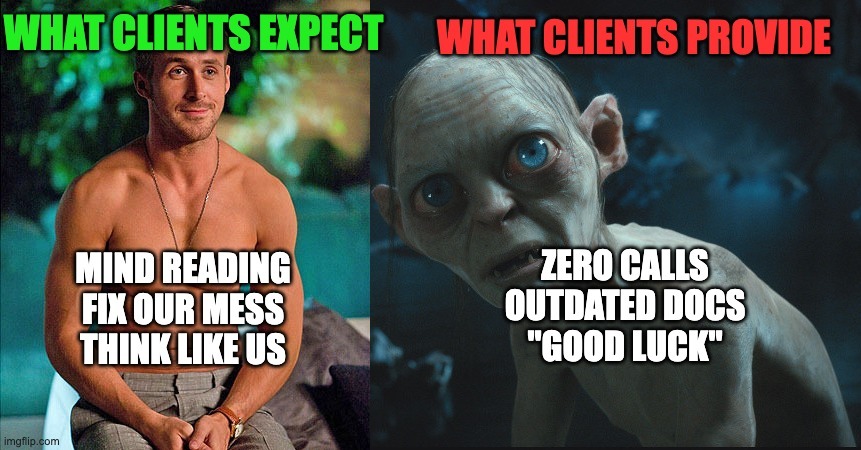
This is exactly what that collaboration looked like.
When collaboration between an agency and a client starts without sharing important company context and expectations, this always leads to three negative outcomes.
Wasted time. An agency spends weeks researching and rewriting. Clients spend time reviewing drafts that could never fully match expectations, because those expectations weren't aligned in the first place.
Emotional frustration. Writers feel like they’re being evaluated on invisible criteria. Clients feel that results don’t match what they “had in mind.” Both sides distrust and disrespect each other.
Defensive feedback. Clients start pointing out issues, trying to fix the output. Agencies start justifying decisions, referencing briefs and documents. Instead of focusing on the draft, sides are trying to prove who’s right.
The most painful part, the client thinks the problem is quality (bad writing, weak research, lack of expertise). But in fact, the problem is context (lack of it).
No amount of writing skill can compensate for that.
Short answer: Don't treat agencies as replaceable resources, while expecting them to produce insider-level work. Help them get there. Here is what I mean:
Do proper onboarding. Onboarding is a conversation, not a document dump. Because nuance lives in dialogue, in your examples, clarifications, follow-up questions. That’s where understanding forms.
I'm not talking about full-fledged employee onboarding, agency onboarding is closer to the context of the task at hand. Start there, and you will set the tone for ongoing work.
Agencies need context. Context isn't about "what you need to write.” It answers how to think. Without understanding this, agencies can do their job perfectly well and still miss the mark. It doesn't mean they're incapable. They just don't have the full picture and their background knowledge is incomplete.
Testing phase should validate the process. Can we work together? Do our processes align? Can feedback flow productively? It shouldn’t test whether an external team can immediately adopt the company’s worldview without ever being given the context.
I'm not going to sign for another project with a client like that without proper onboarding. You can send us 100 documents. We're still doing a call. Or you're paying for our "Discovery phase.”
Lesson learned: We got fired because that was a collaboration failure (not bad writing). The client didn't know what they wanted. They learned during our collaboration. The cost of their education was our time and reputation.
Bad setup produces bad outcomes, regardless of skill.
Have you ever been expected to know everything while being told nothing? Reply and tell me about it.
Kateryna
P.S. If we aren't connected already, follow me on LinkedIn and Instagram. If you like this newsletter, please refer your friends.
P.P.S. Need help with quality content? Zmistify your content with Zmist & Copy.


What questions should you ask a content writer at a job interview to reveal their skills and experience? These are my top 10 content writer interview questions!

Subscribe to From Reads to Leads for real-life stories, marketing wisdom, and career advice delivered to your inbox every Friday.


