
.png)
The advertising slogan about trying harder worked for Avis (a car rental company) in 1962 because they weren’t pretending to be something they weren’t. They were #2 behind Hertz, and instead of being silent about it, they turned it into a promise. Essentially what they said was, “We’re not the biggest, so we’ll serve you better.”
This iconic slogan is a marketing lesson for how to turn a weakness into an advantage.
But most companies aren’t Avis.
It doesn't make any sense for a no-name service-based company operating in a big and competitive market to say "we try harder." They aren't the second. They aren't even the third. They are probably the same as everyone else, so this differentiator isn't working.
And yet, this is how most companies think they differentiate.
They list things like:
None of these are differentiators. Because anyone can say them. And most do.
Few know: you need to create differentiation.
In today's newsletter:
Ask: "Why are we different?"
But it's a tricky question.
Most founders will say:
“We are different because we have a really strong expertise in X technology, and a proven track record.
"We did 500 projects. We worked with companies all over the world. We even served a publicly traded enterprise once.”
"We have a very cool discovery process. Clients are impressed by it.”
Most of these differentiators aren't really different or aren't different in a way that clients care about. For example, if somebody needs you to create a website design, they don't care how many websites you've designed, they want to know you can design their website the way they want.
To answer the question "Why are we different?" you need to create something that differs from how others do the same thing.
Yes, it can be a different discovery process. But not just a fancy new name for that process. Actual different process. You need to know what's wrong in how most companies do this and what you do differently.
Also, keep in mind that discovery can only be a differentiator if this is something you're competing against. For example, if you're a prototyping company. But if what you're competing against, say, is content, your client isn't going to care about how you do the discovery phase. They want content yesterday.
To define how you actually differ, try to do this exercise.
For example, a B2B tech company is trying to create content that brings leads.
Our approach at Zmist & Copy:
Suddenly, you're very different. Because you literally do different things that solve problems your clients are currently experiencing.
Now grab my template and figure out your own differentiation:
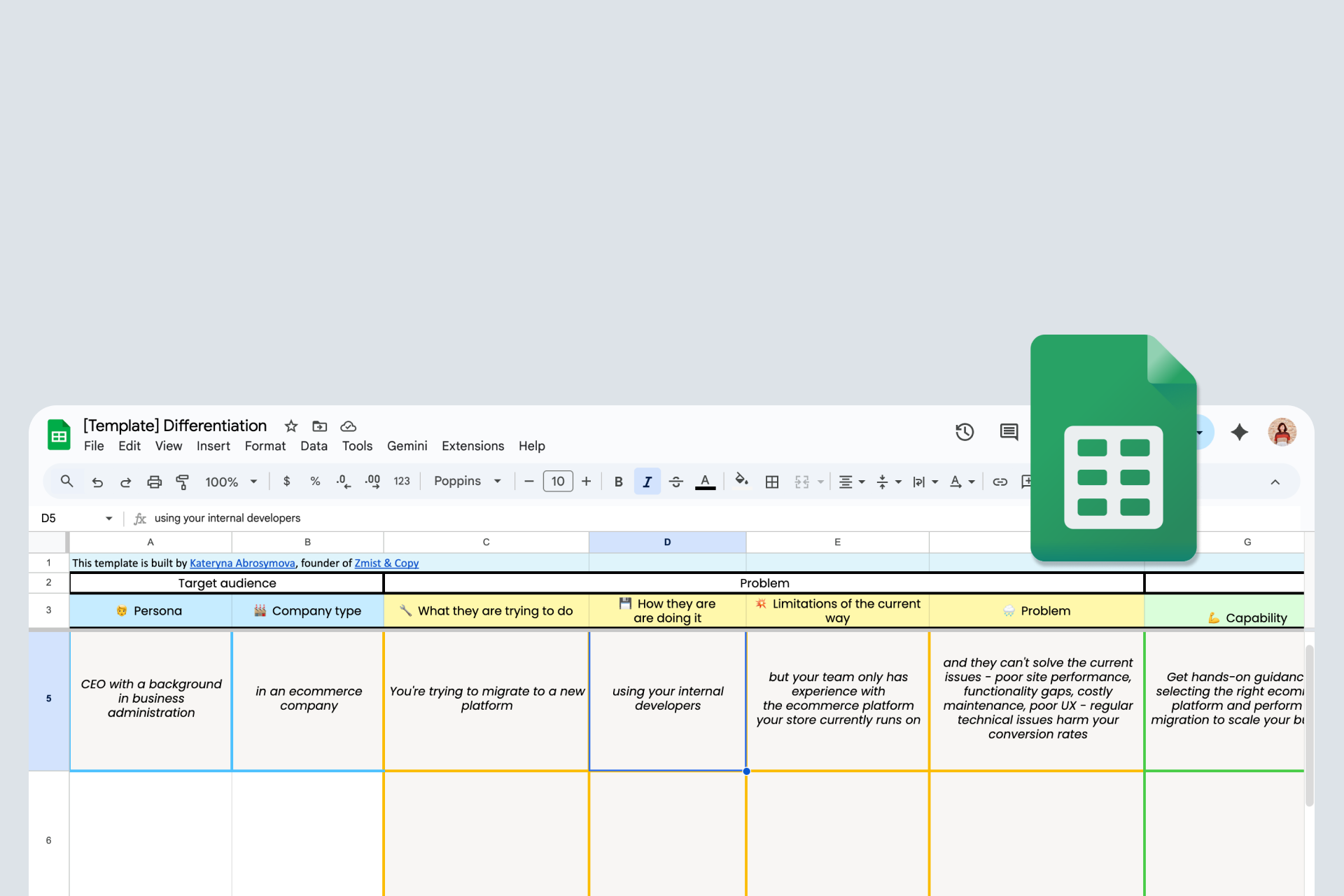
By being specific I mean solving a specific problem for specific clients with a specific process.
For example, at Zmist & Copy, we don't compete on "high-quality content." It's like "we try harder.” Everyone says that.
We compete on fixing a specific problem (content that does nothing), for specific clients (B2B tech companies), with a specific process (strategy, Context Engine, distribution).
The more specific you get, the more different you are.
And the opposite: the broader the market and the more numerous the problems that you solve, the less specific your process becomes and the harder it is for you to figure out your differentiation.
Kateryna
P.S. If we aren't connected already, follow me on LinkedIn and Instagram. If you like this newsletter, please refer your friends.
P.P.S. Need help with quality content? Zmistify your content with Zmist & Copy


Hey, writer! Struggling to write an article? Let me show you how to use ChatGPT to get the job done.

Your Google Doc is not done. The last dimension of the Content Quality Score.
Subscribe to From Reads to Leads for real-life stories, marketing wisdom, and career advice delivered to your inbox every Friday.


